Daito ryu Aikijujutsu is a traditional Japanese martial art transmitted for generations
within the Takeda family of the Aizu domain, and disclosed to the general public by Takeda Sokaku
starting around the end of the 19th century. The main line of this tradition was inherited by Takeda Sokaku's son,
Takeda Tokimune, who then passed it on to Kondo Katsuyuki. Kondo Katsuyuki is the only individual to have received the
Menkyo kaiden (license of full transmission) from Takeda Tokimune,
and as such continues as the leader of the Daito ryu Aikijujutsu tradition today.
In 2019, Kondo Masayuki was appointed as Honbucho after receiving the Menkyo kaiden.
He is currently in charge of day-to-day affairs, and his leadership ensures the tradition
will continue to flourish in the future.
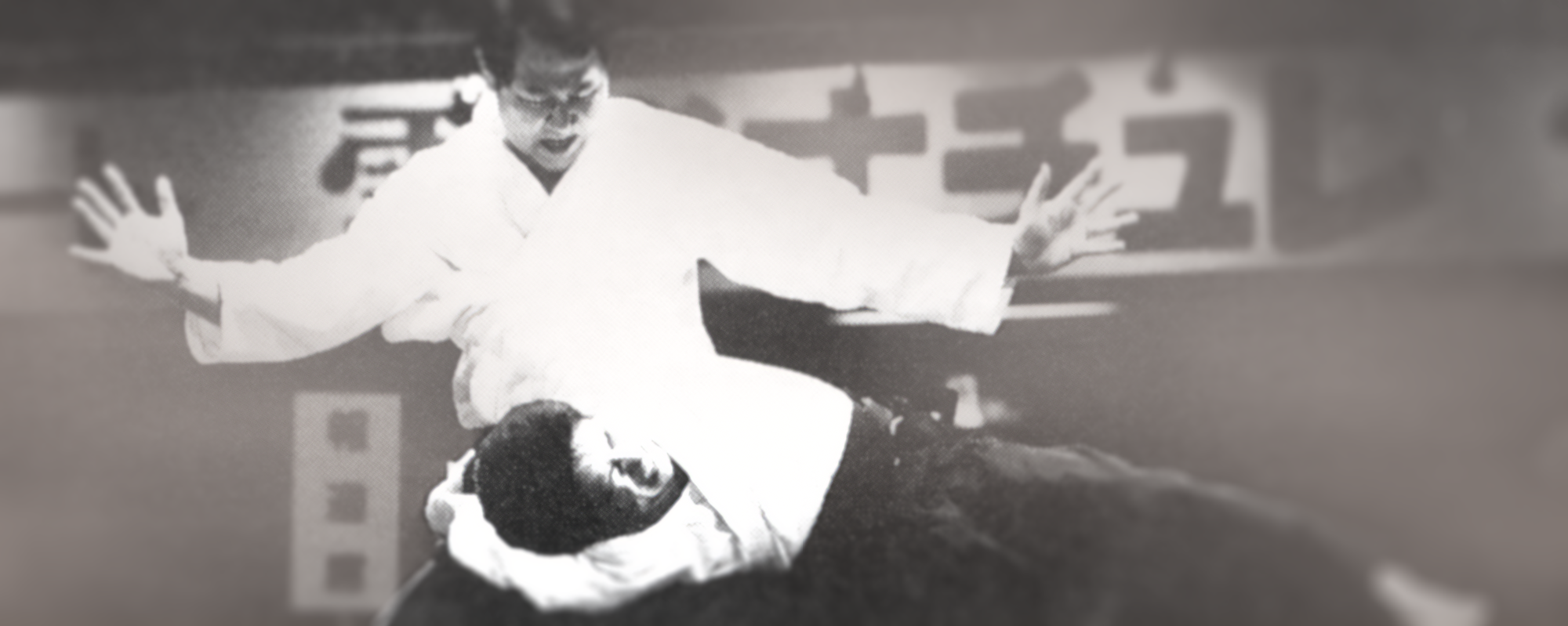
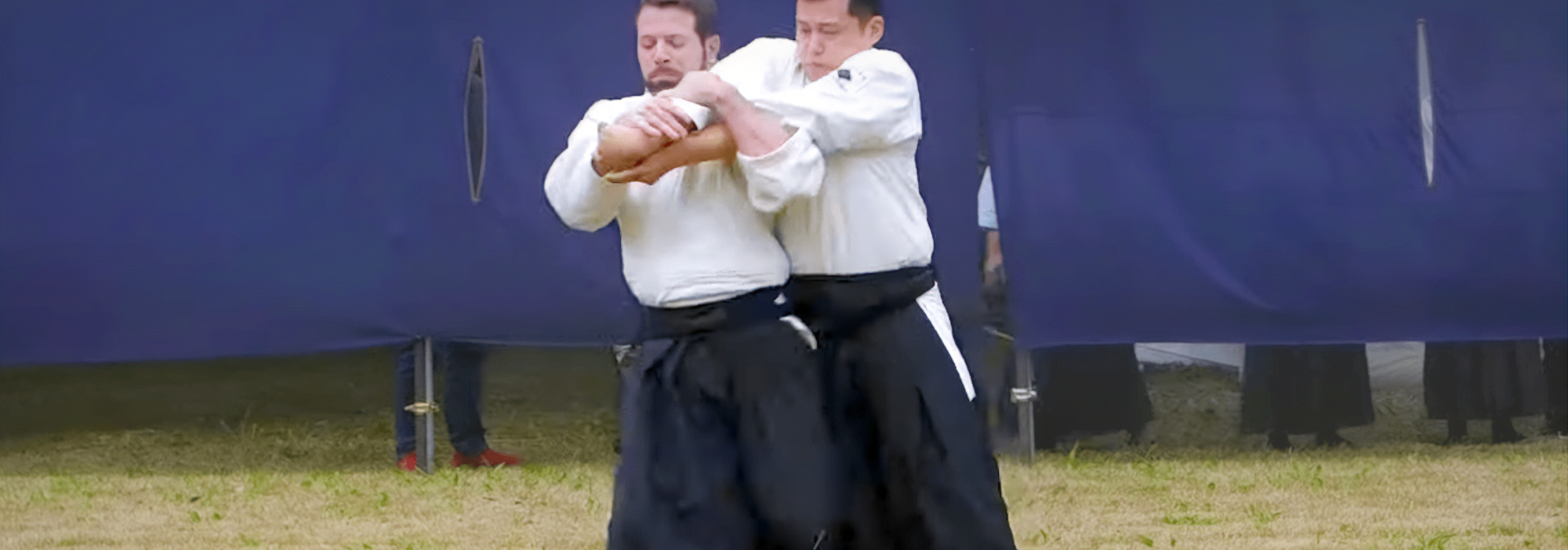
Daito ryu Aikijujutsu is a form of jujutsu, a system of unarmed fighting and minor weapons
techniques to defeat both armed and unarmed opponents. It is noted, as the name suggests, for
emphasizing the principles of aiki (some aspects of aiki are also referred to as kuzushi).
The Daito ryu technical tradition includes both jujutsu and aikijujutsu, but a clear distinction
is made between the two and the emphasis is strongly on the latter.
From ancient times the admonishment to "attack where the opponent has been unbalanced" has been a
fundamental axiom of Asian martial arts. In Daito ryu, the principle of "how to unbalance the opponent"
is referred to as aiki, and a great many of the tradition's oral transmissions and secret teachings pertain
to the various aspects of aiki.
Today, Daito ryu Aikijujutsu is a cultural heritage of the Japanese warrior class with a long history and tradition.
It was developed as a means of self-defense against unprovoked violence, with the ultimate aim of neutralizing violence,
not causing it. This is one of the reasons why Daito ryu relies on using forms (kata) to train in the art,
but does not include any kind of competitive matches. Further, as a classical Japanese martial art, Daito ryu
goes beyond mere self-defense, offering the way to temper one's body and spirit, with the aim of developing personal
character and contributing to the greater social good.
Training curriculum
Training is currently by appointment. Depending on availabilities, training duration
can be between two to three hours long, with a short break mid-way.
Every training starts and ends with formal bowing, and all participants are expected to maintain
a proper, courteous demeanor at all time.
Training timetable
* Time allocations may vary based on training location availabilities
15 minutes
Warm-up
Preparation exercises to minimize the risk of injuries
30 minutes
Callisthenics and fortification exercises
Physical training includes a variety of exercies aimed and developing abilities
cruicial to the practice.
30 minutes
Training drills
Technical exercises to reinforce various essential body mechanics.
These include ukemi, shiko, as well as other paired practices.
Break (15 minutes)
75 minutes
Kata training
Kata training is based on the Hiden mokuroku curriculum. It is divided in
five levels, from ikkajo to gokajo, then further divided into groups of
techniques practiced from sitting (idori), against a standing opponent
(hanza handachi), from standing (tachiai), and when the opponent comes
from behind (ushiro dori).
Required equippment
Judogi. The judogi should be clean, in good condition, and the pants legs have been shortened to end mid-calf.
Hakama. A black Aikido or Iaido hakama in good condition. The bottom of the hakama should slightly brush the top of your feet when standing, and cover the ankle.
Bokuto (wooden training sword). An Ono-ha Itto-ryu bokuto in good condition. The bokuto will be used during fortification training; no kenjutsu will be taught.
Notebook and ballpen. Practitioners are expected to keep notes regarding their practice.
It is strongly recommended to consult with the branch chief regarding the specifics of the equippmentto acquire (size, materials, and so on).
All training participants are expected to take excellent care of their equipment.
Branch chief
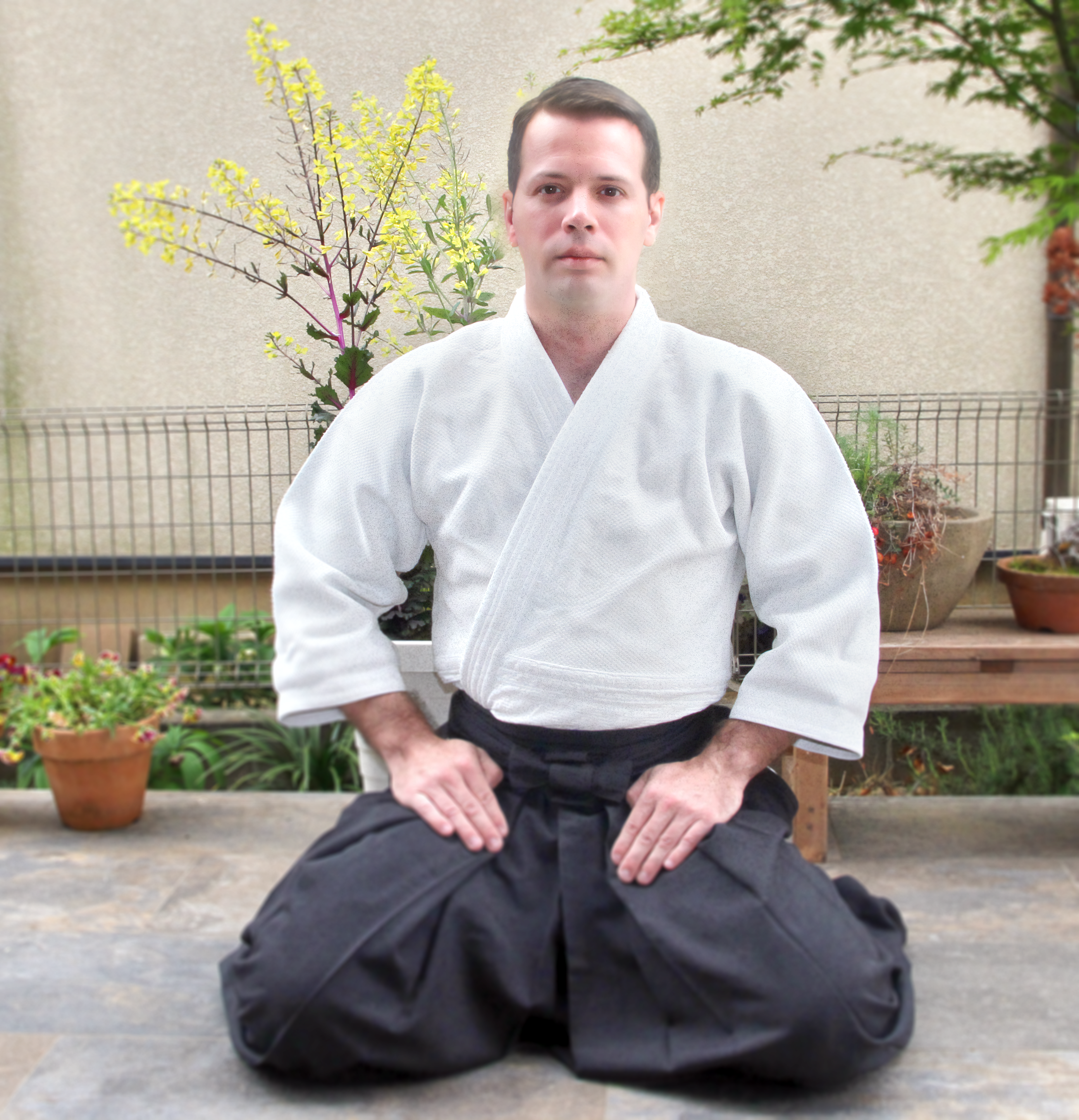
Marc Trudel
4th dan, Daito ryu Aikijujutsu
3th dan, Iaido, All-Japan Kendo Federation
Starting his training in Canada in 2007, Marc
then moved to Japan in 2009 to train under the tutelage of Kondo Katsuyuki sensei. He occasionally act as
an assistant and live translator as needed.
He also frequently participates in demonstrations organized by the Kobduo Shinkokai,
Kobudo Kyokai, as well as for other occasions.
Joining
We welcome anyone 20 years of age or above for training.
Here below you will find the process for joining the Chiba Inage branch.
Any candidate not following the described steps will be automatically ignored.
#1 Send an inquiry
Please contact us through the inquiry section of this site, or by sending an email to
info@daito-ryu.chiba.jp
Please make sure your inquiry includes the following information:
Full name. Please include your name both in usual form (either Kanji or Roman characters), as well as in phonetic katakana
Prefecture, city, and district of residence. A full address is not required.
Past and current experience(s). Please include any relevant martial or traditional practices.
Motivations. What is your interest in Daito ryu, and why are you interested to join training?
General availabilities. When are you generally available for training?
Inquiries may be sent in either Japanese, English, or French. Other languages will be discarded.
#2 Informational meeting
A meeting will be scheduled. This is a relatively informal step; we will be meeting in a public space
to discuss your motivations and the nature of Daito ryu practice. This will also be an opportunity to answer
any initial questions you might have.
Daito ryu training is quite demanding, and requires participants to commit themselves
to practice and study for many years. While the meeting is informal, we expect interested parties
to demonstrate an adequate, polite attitude.
#3 Visit
After the meeting, we will start notify you of future training days and times, so you may come and watch
the next training sessions. We request at least one visit before registration can be accepted, and training start;
however, we suggest interested parties to do two or three visits in total prior to making a final comittment.
The visits are free, and you may come and visit as many time as you wish without
registering.
Again, you will be expected to demonstrate proper attitude and decorum. While we
understand that visitors might not be familiar with the practices and customs specific to Daito ryu,
they are expected to follow indications and behave in an appropriate manner at all times.
At the end of each visits, we will remain available to answer any of your questions.
#4 Registration
You may request to complete registration at any time after your first visit.
Registration documents will be sent to you by email. The document must be appropriately signed and stamped
with your registered seal (or inkan).
The registration documents must be brought with you at the first training session.
Training participation will not be permitted unless the registration process is completed.
#5 Training schedule
Daito ryu follows a koryu format. As such, training only occurs in relatively small groups
so to ensure that the instructor may provide adequate
levels of care, attention, and direct teaching.
After registration, you will continue to receive notification of training days, times, and locations.
Currently, all training occur at sports centers within the Chiba city area. You will be required to
indicate your intent to attend training a day in advance at the latest; please note that
no more than 8 people may currently join training at one time.
Inquiry
Please make sure to have a look at the FAQ section below before sending any questions. All questions
answered in the FAQ will be ignored.
Frequently Asked Questions
What are the registration and participation fees?
You will be required to pay a registration fee as well as a yearly membership fee to the headquarters dojo.
There are currently no participation fees. However,
you will be required to pay a part of the access cost to the training facilities used.
The cost will be divided equally amongst the instructor and the participants.
In what language(s) is the training held?
Training is held in Japanese. While relatively few words are spoken during training,
you are expected to have, or eventually reach, an adequate level of Japanese to function. Limited
assistance in English and French may be provided in certain circumstance.
It is not possible to properly learn a Japanese tradition without sufficient understanding of the language.
Practitioners of foreign origin are expected to actively pursue Japanese study, and are encouraged to
discuss the matter with the branch chief as needed.
What is the difference between Daito ryu and Aikido?
The founder of Aikido, Ueshiba Morihei, is known to have practiced Daito ryu for many years.
There are many historical evidence (particularly between 1922 and 1940) of M. Ueshiba using
the curriculum of Daito ryu as a technical backbone, and supplement it with his own
personal practices and experiences to create what is known today as Aikido.
There are so many lineages of Daito ryu. Which one is the right one?
The main line of the tradition, descending from Takeda Tokimune (currently headed by Kondo Masayuki)
The Takumakai, descending from Hisa Takuma (currently headed by Kobayashi Akihiko)
In Daito ryu, a license of full transmission, or Menkyo kaiden, is required to be
allowed to perpetuate a lineage; the two lineages above were able to provide and present
sufficient historical documentation in that regard.
As stated on the top page, our group's operation is authorized by Kondo Masayuki sensei.
How does aikijujutsu differ from jujutsu?
Aiki is a concept which broadly means "to break the opponent at an instant". It is a multi-faceted
esoteric concept taught in Daito ryu to enhance or enable certain jujutsu techniques that otherwise
might not be as effective or efficient depending on circumstances.
Fundamentally, the basic curriculum of Daito ryu is jujutsu, and aiki is a concept pervasive
to the practice. Strong jujutsu foundations are essential to the development of aiki in Daito ryu.
Are there kyu and dan rankings in Daito ryu?
While some branch dojo issue kyu ranking, the Chiba city branch does not.
There are dan rankings in Daito ryu, based on the progression and proficiency with the curriculum.
Examinations are conducted once a year during special training sessions held by the headquarters director.
Do I need prior experience in martial arts?
No prior experience is required. In fact, we expect participants to leave their background
at the door for the duration of training. While some of the practices of Daito ryu might initially feel familiar,
there are subtle but crucial differences which all practitioners must pay attention to so to gain benefits out of the training.
Am I allowed to practice elsewhere in parallel to training in Daito ryu?
There are no limitations. However, we request you disclose other training you follow or intend on following
(tradition, name of the instructors, and starting date).
As a branch member, would I have any obligations or responsibilities?
Your responsibility would be to focus on your training. In other words, you would be
expected to maintain a good physical condition, and do solo training between each training
session to continue nurturing proper body mechanics.
Senior members are not currently requested to help with instruction beyond showing
a good example of proper practice to junior members.